
Most hotels assume the booking decision happens when a guest clicks “Book Now.”
In reality, that decision is often made much earlier or sometimes much later than teams expect.
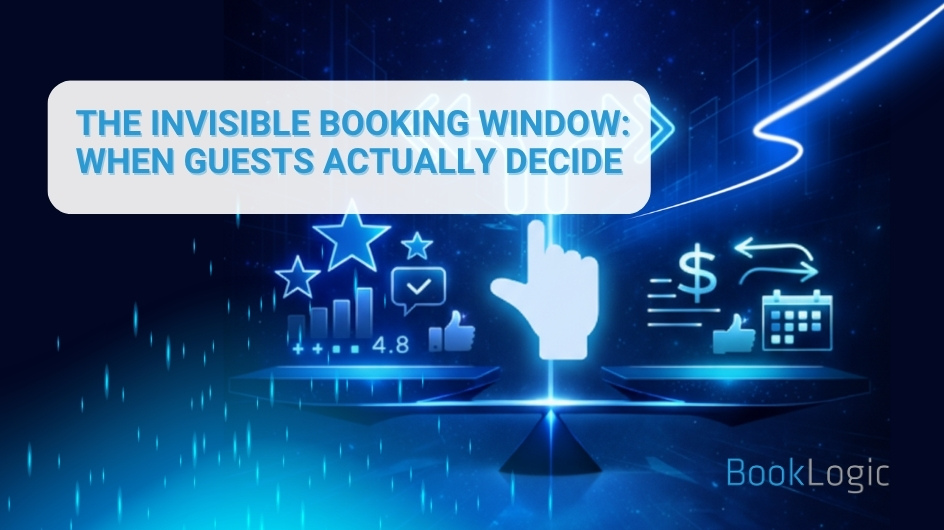
This gap between assumption and reality is what we call the invisible booking window: the short but critical period when a guest shifts from interest to intent. It often happens quietly, without direct interaction, and it’s where most conversion opportunities are either secured or lost.
Booking Decisions Are Rarely Instant
Today’s guest journey is anything but linear.
Guests browse multiple properties across devices, compare prices and reviews over time, pause, return, and reassess. Long before the final click, they make a series of small, cumulative decisions.
By the time a guest reaches the booking engine, their choice is often already leaning in one direction for or against your property.
The challenge is that this process leaves very few visible signals.
No forms. No questions. No clear indication of intent.
Yet this is where revenue is truly decided.
Why Hotels Miss the Invisible Window
Most hotel technology stacks are designed to respond, not anticipate.
They activate when a chat message arrives, a form is submitted, or a booking starts.
But the invisible booking window exists before all of that.
During this phase, guests are comparing alternatives, evaluating reviews, judging price fairness, and deciding whether they trust the property enough to commit.
If systems aren’t built to recognize and act during this stage, hotels end up reacting after the moment has passed.
Intent Signals Are Subtle But Real
Even without direct interaction, guests constantly leave intent signals:
- Repeated views of the same room type
- Price checks across different dates
- Review-heavy browsing patterns
- Traffic from comparison or meta channels
- Hesitation between availability and checkout
Individually, these actions may seem insignificant. Together, they reveal exactly where a guest is in the decision cycle.
The issue isn’t a lack of data, it’s the lack of a system that connects it.
Why Systems Matter More Than Touchpoints
When chat, website behavior, pricing, availability, distribution, and marketing operate in silos, the invisible booking window stays invisible.
But when these elements function within a single integrated system, everything changes:
- Intent can be identified in real time
- Messaging becomes contextual instead of generic
- Offers align with decision stage, not assumptions
- Timing turns into a competitive advantage
The objective isn’t to push harder. It’s to be present at the exact moment certainty begins to form.
The Cost of Missing the Moment
When hotels fail to act during this window, guests default to OTAs, price sensitivity increases, trust shifts elsewhere, and direct conversion opportunities disappear.
This isn’t a marketing issue. It’s a systems issue.
Turning the Invisible Into Action
Hotels that perform best today don’t wait for explicit signals.
They build systems that understand behavior, timing, and context.
They don’t focus on how many conversations happened.
They focus on whether they acted when the guest was ready to decide.
Because in modern hospitality, revenue isn’t lost at checkout.
It’s lost earlier quietly and systematically.
Where BookLogic Fits In
Recognizing the invisible booking window requires more than isolated tools. It requires a system designed to understand intent as it forms. BookLogic is built around this exact challenge.
By unifying website behavior, pricing, availability, reviews, distribution, and communication in one environment, BookLogic helps hotels move from reactive responses to proactive decision support.
Instead of waiting for guests to initiate contact, hotels using BookLogic can:
- Detect decision-stage signals in real time
- Align messaging and offers with guest intent
- Reduce dependence on external channels during hesitation
- Act while conversion is still flexible
The outcome isn’t more interaction.
It’s better timing, clearer direction, and stronger decisions on both sides of the booking journey.
Because the invisible booking window doesn’t reward speed alone.
It rewards systems that understand when and how guests actually decide.
And that’s exactly where BookLogic operates.
 English
  Türkçe
  Hrvatski
  Português
  Español
  Français
  Italiano
  العربية
  简体中文
简体中文  Deutsch
  Русский